


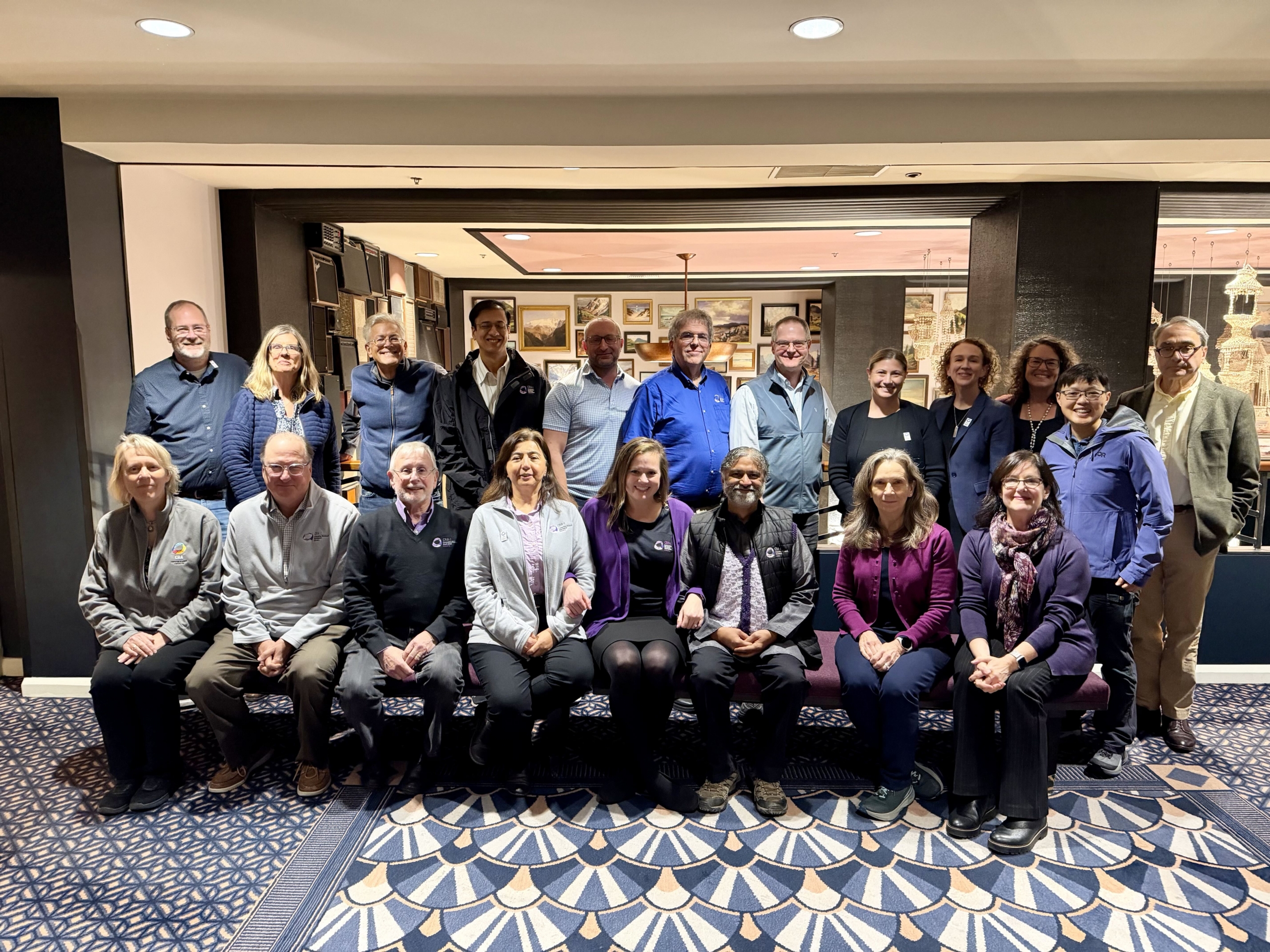
CRA-I Steering Committee and Council
November 2026
CRA is reviewing all programs and practices and will implement any necessary revisions due to federal Executive Orders and/or federal funding agency guidance.
We remain dedicated to our mission and service to the computing research community.






The Models Are Ready. Is the Rest of Healthcare? Takeaways from CRA-Industry’s Boston Salon on AI in Medical Research and Healthcare
/in CRA-I Announcements, CRA-I Event, CRA-I General Information, Salon GatheringBy Lisa Amini (IBM and CRA-I Steering Committee), Slawek Kierner (Former Chief Digital and AI Officer, Olympus), Daniela Rus (MIT), Alfred Spector (MIT/Blackstone and CRA-I Council), Divesh Srivastava (AT&T and CRA-I Co-Chair), and Helen Wright (Senior Manager, CRA-Industry)
On October 12, 2026, CRA-Industry (CRA-I) convened its latest Salon Gathering at Hampshire House in Boston. The topic was “AI in Medical Research and Healthcare.” Daniela Rus (MIT) and Slawek Kierner (Former Chief Digital and AI Officer, Olympus) served as headliners, and the evening was organized by Lisa Amini (IBM and CRA-I Steering Committee), Alfred Spector (MIT/Blackstone and CRA-I Council), and Divesh Srivastava (AT&T and CRA-I Co-Chair).
The CRA-I Salon Gatherings are small, invitation-only dinners that follow a Jeffersonian format: one conversation around one table. Earlier salons covered AI in fintech in New York and AI for systems in the Bay Area. In Boston, about 15 people attended, including academic computer scientists, clinicians, health-tech founders and executives, investors, a health-law scholar, and a medical-device maker. By design, there was no expected deliverable. A candid conversation and new connections count as a success. The discussion was held under the Chatham House Rule, so the takeaways below are not attributed to individuals.
One message came through early and stayed all evening: the models are good enough now. What holds AI back in medical research and healthcare is everything around the model.
1. The Bottleneck Is Data, Not Models
Health data is split across hundreds of systems that each code and document things differently. Devices in the same hospital room don’t always sync or share a common language. Coding standards shift over time and quietly break models. A model trained in one large health system often fails at the next.
Participants also noted that most healthcare AI is trained on electronic medical record (EMR) data, which is a summary rather than the source. Values are charted periodically and lose context such as device settings, alarm states, and signal quality. That is often fine for population-level questions, but not for the time-critical decisions made at the bedside. Participants discussed cleaning data once, at the source, through open, vendor-neutral device standards such as IEEE 11073 SDC, rather than cleaning it again for every project. Standards like these are pre-competitive infrastructure.
2. Incentives Move Data More Than Technology Does
Health systems now know their data is valuable, and they evaluate data sharing mostly in terms of risk and revenue. A single data use agreement can take a year or more, even for non-commercial research. Participants recalled that past data-sharing efforts in science succeeded only when funders and journals required sharing. Others pointed to the European Health Data Space as one possible model, and to procurement requirements for open interoperability as a lever health systems already hold. One proposal was that a neutral body could develop template data-sharing agreements for use across institutions, states, and countries. Even inside a single health system, the benefits of an AI tool often land in one budget while the costs and workflow changes land in others, with no single leader owning the result.
3. Bring the Model to the Data
If data cannot move, perhaps the model should. Fine-tuning and adaptation inside each institution, with smaller, task-specific models running in-house or on devices near the patient, may be the practical path. Smaller and mid-sized health systems may need consortia to afford it. Participants also flagged a newer concern: how people interact with AI is itself valuable data that needs protecting.
4. Trust Comes in Layers
Regulators, institutions, and the clinician at the bedside each decide for themselves whether to trust a tool, and the bedside is often the hardest. Clinicians check AI output against the chart until it earns their confidence. The opposite risk is just as real: in one study described at the table, most surgical trainees and junior surgeons in a simulated exercise (without patients) followed AI guidance that had been deliberately shifted outside the safe zone. Patients may care less about explanations than about trusted signals such as regulatory approval, provenance, and their own doctor’s confidence. Provenance starts at the device: which device, which settings, what signal quality.
5. Decide What We’re Optimizing For
Many arguments about regulation are really disagreements about goals: privacy versus lives saved, explainability versus proven effectiveness, representative clinical trials versus speed, perfect versus available. Trustworthy AI may not be a property of an algorithm at all, but a judgment about a specific use in a specific setting. Point-of-care AI and population-level AI optimize for different goals and should be evaluated differently. Simpler, lower-risk uses, such as Utah’s pilot allowing AI to process routine prescription renewals, may be better places to start than high-stakes devices.
6. Keep Humans in Charge, and Learning
The appealing picture is AI as a “guardian”: a second pair of eyes that catches what a tired clinician misses while the clinician stays in charge. But a good system should also teach. In surgery, most AI so far has gone into measuring and improving surgeons’ skill rather than into autonomy. A tool that solves a problem without teaching anything leaves us no wiser, and AI can shift work onto reviewers instead of reducing it. Clinicians are learning to code, and technologists need to spend time in clinics. Building safe systems still takes engineering discipline, with small, verifiable parts, not just clever prompts.
7. Translation Is an Operating-Model Problem
Data, regulation, trust, workflows, financial incentives, and staff readiness are linked, so fixing one rarely produces clinical progress on its own. An isolated algorithm is not a viable unit of implementation. Medical centers need ways to continuously deploy, monitor, verify, adjust, and govern AI as settings and technology change. Keeping a model trustworthy requires continuous evaluation, not a one-time sign-off. This also explains why operational AI (scheduling, documentation, coding) is advancing faster than patient-facing tools: goals are explicit, feedback loops are fast, and returns are easy to measure.
Open Questions for the Computing Research Community
The discussion also surfaced several research questions that could help the computing community address these challenges and advance the responsible use of AI in healthcare:
From Conversation to Action
As one participant put it in the closing round, the conversation has shifted from building good models to building the infrastructure to deploy them. The evening ended on an optimistic note about wider access to data and the pace of innovation. Attendees are continuing the discussion through a shared document and several proposed follow-on efforts. Follow-on ideas from the table include a standard process for sharing data and models across institutions and borders, and standards for what AI developers must disclose to the clinicians who use their tools.
CRA-I and the organizers thank every participant for a generous and candid conversation.
To learn more about CRA-Industry and future Salon Gatherings, visit cra.org/industry.
Beyond the Hardware: How Industry Partnerships Can Expand AI Computing Access
/in CISE, CRA Event, CRA-I Announcements, CRA-I Event, CRA-I General Information, NSF, Report, TIPBy Matt Hazenbush, Director, Communications and Member Engagement
Building the AI infrastructure needed to support the next generation of research, education, and innovation is a challenge that universities cannot solve alone. As demand for advanced computing resources grows, partnerships among academia, industry, government, and philanthropy are becoming increasingly important to expanding access and developing a workforce prepared for an AI-driven economy.
A new report from the Computing Research Association (CRA), From Vision to Practice: A Blueprint for State and Regional AI Computing Infrastructure and Educational Access, examines how Florida, Pennsylvania, Utah, and New York are developing shared AI computing infrastructure through different combinations of public investment, institutional collaboration, and private-sector support.
Read the Report
Authored by Erik Deumens, University of Florida; Ian Fisk, Simons Foundation; Manish Parashar, University of Utah; Barr von Oehsen, Pittsburgh Supercomputing Center; and Helen Wright, CRA, the report offers practical insights into the opportunities and challenges of building sustainable state and regional AI ecosystems.
The report builds on a 50-state AI computing strategy advanced by Chris Malachowsky, NVIDIA cofounder, Fellow, and Senior Vice President. Drawing on the University of Florida’s AI transformation, his vision calls for states to develop shared computing infrastructure that extends AI research and educational opportunities across their higher education systems. The report examines how four states are translating that broader vision into practice through different funding, governance, and partnership models.
For industry research leaders and potential partners, the report offers an important perspective: investments in AI infrastructure can create opportunities that extend well beyond the computing systems themselves, supporting research collaboration, workforce development, and regional innovation.
Industry Partnerships in Practice
The report highlights several ways that industry and philanthropic partners can help catalyze state and regional AI infrastructure initiatives.
Florida: Philanthropy as a catalyst for institutional transformation
In 2020, NVIDIA and Malachowsky donated a $60 million AI supercomputer to the University of Florida, helping accelerate an ambitious effort to integrate AI across the university’s research and educational mission.
The investment was accompanied by commitments from the university and state, including expanded computing facilities and support for new AI faculty positions. Florida’s experience illustrates how an initial private-sector investment can catalyze sustained institutional and public commitments.
Utah: Industry expertise and infrastructure delivery
The University of Utah’s Redtail AI Factory demonstrates a different model. Through a multiyear agreement with Hewlett Packard Enterprise (HPE), the university is using vendor-provided infrastructure and lifecycle management services to accelerate deployment of advanced AI computing capabilities.
Powered by NVIDIA technology, the initiative is designed to support research, education, and innovation across Utah. The state has also signed a memorandum of understanding with NVIDIA focused on AI workforce training and research.
Utah’s approach highlights opportunities for industry partners to contribute not only technology, but also deployment expertise, ongoing services, and support for broader AI ecosystems.
“Industry partnerships can help universities move more quickly from planning to implementation by bringing together advanced technology, technical expertise, and operational support. The opportunity is not simply to deploy computing infrastructure, but to create sustainable capabilities that support research, education, and innovation across an entire state,” said Manish Parashar, Chief AI Officer, SCI Executive Director, Chair in Computational Science & Engineering, and Presidential Professor of Computer Science at the University of Utah.
Connecting AI Infrastructure to Workforce Development
For industry, the value of these partnerships extends beyond providing computing capacity.
Access to advanced AI infrastructure can enable universities to develop educational programs that give students practical experience with technologies increasingly used in research and industry.
Florida’s AI Across the Curriculum initiative extends AI education across disciplines, while Utah is developing training and experiential learning opportunities across its higher education system.
For companies interested in strengthening regional talent pipelines, such initiatives offer potential avenues for collaboration with academic institutions and state partners.
Building Partnerships That Last
The report also makes clear that successful AI infrastructure initiatives require more than an initial investment in hardware. Technical staffing, user support, governance, institutional commitment, and sustainable funding all play essential roles.
The emerging initiatives in Pennsylvania and New York illustrate how states are organizing institutions around shared infrastructure goals. Pennsylvania’s Keystone AI + Quantum Factory is developing a collaborative approach among seven research universities, while New York’s Empire AI consortium is pooling public, institutional, and philanthropic resources to expand access to advanced computing.
“Pennsylvania has world-class research universities, but also many smaller institutions with talented researchers who lack access to advanced AI infrastructure. The Keystone AI + Quantum Factory is about connecting those institutions and expanding access across the state,” said Barr von Oehsen, Executive Director of the Pittsburgh Supercomputing Center. “Making that vision a reality requires partnership. Government can help establish statewide priorities, industry brings real-world problems and expertise, and philanthropy can support long-term sustainability. Hardware matters, but the harder and more valuable work is building the trust and shared governance that make these partnerships last.”
For industry partners, these models underscore the importance of understanding how infrastructure investments fit within broader regional strategies — including who will operate the systems, how access will be allocated, and how initiatives will sustain themselves.
An Opportunity for Industry Engagement
The report builds on discussions from the CRA–National Science Foundation (NSF) Industry/Philanthropy Summit on Potential NAIRR State Hubs for Educational Transformation, which examined how partnerships could help expand access to AI computing and educational opportunities.
As more states explore investments in AI infrastructure, industry has an opportunity to contribute expertise, resources, and partnerships that help translate computing capacity into lasting research, educational, and economic benefits.
Read the full report: From Vision to Practice: A Blueprint for State and Regional AI Computing Infrastructure and Educational Access
CRA Launches 2026 P2P Survey to Gather Industry Input on AI and Computing Education
/in CERP, Community Event, Community Updates, CRA-I AnnouncementsThe Computing Research Association (CRA) has launched the 2026 CRA Practitioner-to-Professor (P2P) Survey, inviting industry professionals to share their perspectives on how artificial intelligence (AI) is reshaping expectations for computing graduates. The survey is open until December 31st, 2026.
As AI continues to transform how work gets done across the computing landscape, the question of what students should learn — and how they should be prepared for the workforce — has taken on new urgency. The P2P Survey is designed to help answer that question by collecting structured input directly from practitioners working in industry.
At its core, the survey aims to create a timely feedback loop from industry back to universities, ensuring that computing programs better reflect real-world needs and evolving workforce demands.
“Computing departments are actively working to understand how rapid advances in AI are changing the expectations placed on graduates,” said Tracy Camp, Executive Director and CEO of CRA. “This survey provides a direct way for industry professionals to share their perspectives and help inform how academic programs evolve in response.”
Building on Strong Industry Engagement
The 2026 survey builds on the success of CRA’s previous P2P effort, which gathered input from over 1,000 practitioners across a wide range of roles, experience levels, and technical areas. That feedback was shared with computing department leaders and has already contributed to ongoing conversations around curriculum, workforce preparation, and the role of foundational skills in computing education.
Read the July 2026 ACM Inroads article summarizing the findings
This year’s survey takes a deeper look at emerging questions, particularly around the impact of AI on technical work and the skills that matter most for early-career professionals.
“We’re hearing increasing interest from both academia and industry in understanding what has changed and what hasn’t when it comes to preparing students for computing careers,” said Rahul Simha, Professor of Computer Science at The George Washington University and a lead on the P2P initiative. “This survey gives practitioners a structured way to contribute their experience and help shape that conversation.”
A Community-Driven Effort
The P2P Survey is supported by leading computing organizations, including Association for Computing Machinery (ACM), ABET, CSAB, and the IEEE Computer Society, reflecting broad support for strengthening the connection between industry needs and academic preparation.
By participating, industry professionals contribute to a shared effort to improve computing education and better prepare the next generation of graduates entering the workforce.
Share Your Perspective
The 2026 CRA P2P Survey takes approximately 20 minutes to complete and is open to professionals working in industry or industry-like environments, including startups and government organizations. It will close on December 31st, 2026.
Take the survey here
CRA encourages participants to share the survey with colleagues and peers to help ensure a broad and representative set of industry perspectives.